Assigning Parts – The Cast of Characters
We have all been to seders where each person reads a paragraph from the haggadah followed by the next person. The problem with this approach is that the people at the other side of the table aren’t paying attention. At the most basic level it is important to label paragraphs and assign the parts to each person. The following cast of characters is handed out with the haggadah at our seder.
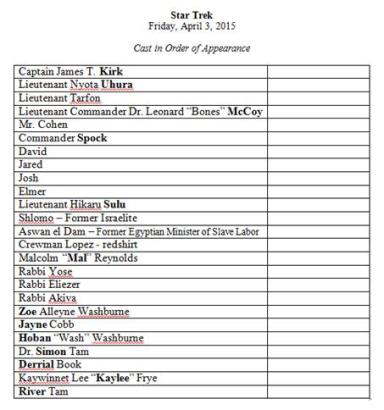
The haggadah is actually begging to be broken out into parts. We recite what Rabbi Tarfon said and what Rabbi Gamiliel said. Rabbis Yose, Eliezer and Akiba are quoted as having different opinions as to the number of plagues there were. The haggadah text is in the third person. Instead you can have each rabbi played by a different guest. All you need to do is to add the text similar to below in bold italicized print :
Rabbi Eliezer: You are wrong. Fifty is not the correct number. I believe that you should multiply by four the plagues counted by Rabbi Yose. For each plague the Holy One, Blessed is he, inflicted upon the Egyptians in Egypt was equal to four plagues. For it is written that He sent upon them his fierce anger: wrath, fury, trouble, and a band of emissaries of evil.
Rabbi Gamliel is mentioned as he felt that the Pesach, Matzah and Maror need to be explained. This creates a part for Rabbi Gamliel and possibly three students. You don’t need to write the dialogue. It is already in the haggadah.
Rabbi Gamliel: (pointing to Pascal Lamb) Why did our fathers eat a Passover offering? It is because the Holy One, Blessed is He, passed over the houses of our fathers in Egypt, as it is written: You shall say “It is a Passover offering for HASHEM, Who passed over the houses of the children of Israel in Egypt when He struck the Egyptians and spared our houses; and the people bowed their heads and worshipped.”
Chaim: (pointing to the Matzah) The reason for eating Matzah is just as important. It is because there was not enough time for the dough of our ancestors to rise when the Holy One, blessed be he, revealed Himself to them and redeemed them, as it is written: “And they baked the dough which they had brought out from Egypt into cakes of unleavened bread;
In fact, the four sons can speak for themselves also with their father explaining how he responds to their questions.
David: Excuse me dad. What are the testimonies, decrees and ordinances which HASHEM, our God, has commanded us?
Mr. Cohen: Son, I am going to explain to you all the laws of Passover even to the last detail, that one may not eat dessert after the Afikomen.
Kirk: He seems to be a very wise son. However, I don’t know what this has to do with the flight deck.
Jared: Hey Pops! What does this service mean to you?
Kirk: And this bigmouth must be the wicked son.
Mr. Cohen: Jared, by using the expression “to you”, it is evident that our service has no significance for you. You know son, it is because of what the Lord did for me when I came out of Egypt. For me, but not for you. If you had been there you would not have been redeemed.
There is also a role for Rabbi Tarfon who talks about staying up all night. His remarks are in the haggadah.
Narrator: Our story opens today at the post office of Frostbite Falls, population 48. Although the town is small the post office is in operation all day and all night.
Tarfon: Excuse me, but did you say “all night”? That reminds me of the time I was with Rabbis Eliezer, Joshua, Elazar, and Akiba many years ago in B’nai B’rak. We sat at the Seder table all night discussing the liberation from Egypt until our disciples came in to tell us it was time to recite the morning Shema. Rabbi Elazar, who was nearly seventy years old at that time, could not understand why the exodus from Egypt should also be mentioned in the evening service. That was until Ben Zoma explained it by quoting the verse “That you may remember the day you went forth from Egypt all the days of your life. The days of your life would imply the daytime only. All the days of your life includes the nights also’
In addition to the characters above you can add some extra ones. I have created Shlomo the Israelite and Aswan the former Egyptian minister of slave labor. There is enough in the Maggid section to provide the text for their parts. For example:
Shlomo: Nice to meet you. The Haggadah tells the story of our exodus from Egypt. Originally our ancestors were idol worshippers. God commanded Abraham to leave his country and his father’s home in order to become the founder of “a great nation”. Abraham had a son Isaac, who had two sons, Jacob and Esau. Esau was given Mount Seir. Jacob and his family ended up in Egypt and became a mighty, numerous nation. The Egyptians did evil to us and they afflicted us, and imposed upon us hard labor. We cried out to the Almighty God of our Fathers; and God heard our voice, saw our affliction, our burden and our oppression. God brought us out of Egypt with a mighty hand and an outstretched arm, with great awe, signs and wonders. I’m sorry, you in the moustache and funny hat, who are you?
You can build an entire story around the haggadah and add additional characters. To include my youngest daughter I added the line “I’m hungry. Is it time to eat?” We have given that part to the very youngest guests who seem to be able to handle the line even if they can’t read.
 Creative Seders